
GrammarVista.com is an article-based website covering English grammar, vocabulary, punctuation, possessives, sentence structure, synonyms, and everyday expressions. However, its recent publishing extends well beyond language education into technology, business, health, product news, sports, and other general-interest subjects.
The most important distinction is that GrammarVista.com currently appears to be a content website rather than an interactive grammar checker. Readers can browse explanations and examples, but the public navigation reviewed for this article did not show a tool where users can paste text and receive automated corrections.
That makes the site potentially useful for exploring a language question, collecting example sentences, or discovering alternative phrases. Nevertheless, readers should verify important rules against the style guide, dictionary, or professional standard relevant to their work.
A Quick Map of the Website
| Area | What readers can expect |
|---|---|
| Main format | Free, browser-based articles |
| Original focus | English grammar and vocabulary |
| Language subjects | Possessives, punctuation, compound words, sentence structure, synonyms and common expressions |
| Recent coverage | Technology, business, health, sports, products and general news |
| Interactive grammar checker | Not visible in the reviewed public navigation |
| Access requirements | Articles can generally be opened without creating an account |
| Site information | About, contact, privacy, disclaimer and terms pages are available |
| Best use | Preliminary explanations, examples and writing ideas |
The Site Has Two Different Identities
Understanding GrammarVista.com becomes easier when its content is divided into two broad layers.
The language-learning archive
The site’s name, About page and Grammar category present it as an English-learning resource. Its language archive contains articles about questions such as:
- How to form singular and plural possessives
- Whether a name ending in “s” needs another “s”
- Alternatives to common email expressions
- Synonyms for frequently repeated words
- Greeting and reply ideas
- Vocabulary choices for personal and professional writing
Many of these articles use lists and example sentences. This format can help a reader compare alternatives quickly, particularly when drafting an email, message, essay or social post.
The broader publishing section
The current homepage and blog archive have a much wider scope. Recent entries include subjects involving software, technical services, health treatments, manufacturing, international business, skincare and sports viewing.
This broader coverage does not automatically make an article incorrect. However, it means the domain name alone is no longer a reliable guide to the subject or authority of every page. A reader should evaluate a grammar lesson differently from a medical, financial or technical article.

How to Use GrammarVista.com Effectively
A practical search process can make the site more useful while reducing the risk of applying incomplete advice.
1. Begin with a specific question
Search for the exact distinction you need instead of browsing broadly. For example:
- Is “client’s” or “clients’” correct?
- What is another way to say “received with thanks”?
- Should a person’s name ending in “s” take an additional “s”?
- What is the difference between a plural and a possessive?
A narrow question makes it easier to judge whether an article delivers a direct answer.
2. Separate grammar rules from style choices
Some writing questions have one standard answer. Others depend on the style guide being followed.
Possessive names ending in “s” are a useful example. A school, newsroom, academic journal and book publisher may follow different editorial conventions. Therefore, two forms can appear in published writing even when each organization is applying its own rules consistently.
When reading an article, ask whether it identifies the relevant style system and applies it correctly. If your employer, teacher or publisher has supplied a style guide, that requirement should take priority over a general web article.
3. Examine the examples, not just the heading
A title may match your question while the examples reveal whether the explanation is genuinely useful. A good example should:
- Demonstrate the stated rule clearly
- Match the surrounding explanation
- Distinguish singular, plural and possessive forms
- Use natural sentences
- Avoid introducing an unrelated exception
If an example appears to contradict the rule, verify it before copying the construction.
4. Check the page’s date and byline
Language changes gradually, but recommendations about professional style, technology, health or products can become outdated more quickly. Check when the page was published and whether it names an author.
A byline is helpful, although a name by itself does not establish expertise. For higher-stakes subjects, look for a detailed author biography, relevant qualifications, primary sources and a clear editorial or review process.
5. Confirm important information elsewhere
GrammarVista.com can serve as the first stop rather than the final authority. The appropriate verification source depends on the task:
- Use the required style manual for academic or professional formatting.
- Consult a reputable dictionary for spelling, meaning and usage.
- Check an official product source for specifications or compatibility.
- Use licensed medical professionals and recognized health authorities for treatment decisions.
- Consult official regulators or qualified advisers for legal and financial questions.
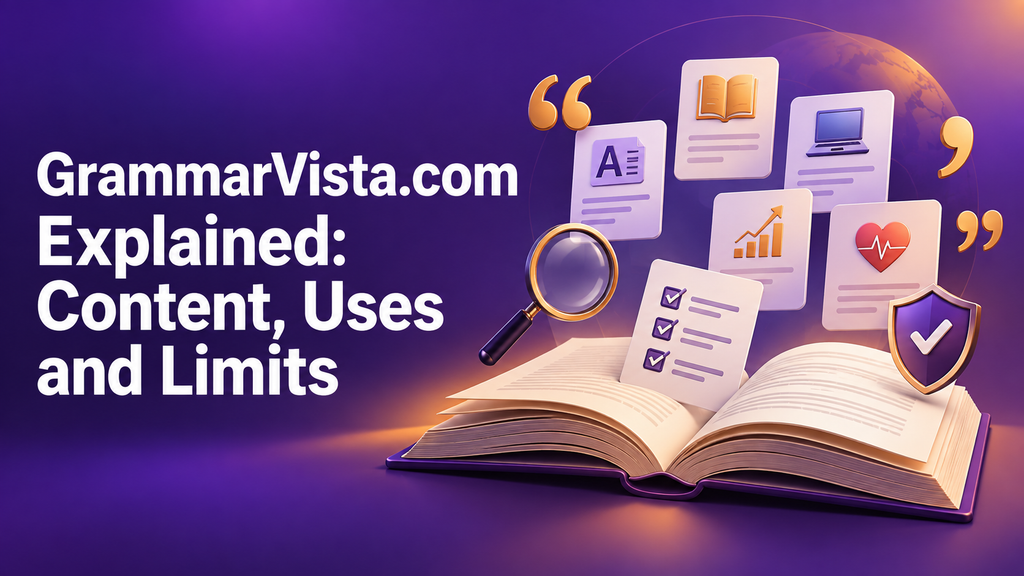
This extra check is especially important when a mistake could affect grades, employment, money, health or safety.
A Simple Reliability Test for Any Article
Before relying on a page, score it mentally against the following questions.
| Test | What to look for |
|---|---|
| Intent match | Does the page answer the question in its title? |
| Clear rule | Is the central explanation stated directly? |
| Context | Does it explain when the advice applies? |
| Examples | Are the examples correct, natural and varied? |
| Source transparency | Are important claims connected to identifiable authorities? |
| Author transparency | Is the writer’s relevant background explained? |
| Recency | Could the information have changed since publication? |
| Commercial influence | Does the article promote a service or link to a provider? |
| Risk level | What happens if the information is wrong? |
A page does not need to be academic to be helpful. Still, the amount of evidence required should increase with the potential consequences of using its advice.
Where GrammarVista.com Can Be Helpful
The site’s strongest practical value is in low-risk language exploration.
Finding alternative wording
Articles containing synonyms, greetings and email phrases can help readers escape repetitive wording. However, tone matters. A warm phrase suited to a friend may sound inappropriate in a formal complaint or business proposal.
Instead of copying an alternative automatically, consider:
- Who will receive the message?
- Is the relationship formal or casual?
- Does the phrase sound natural in the relevant country or workplace?
- Does it preserve the original meaning?
Reviewing possessive forms
The site contains numerous pages about apostrophes, plurals and possessives. These can be useful when a reader needs several examples of the same underlying pattern.
Once the pattern is understood, it is better to apply the rule to the new sentence than to search for a separate article about every noun.
Generating examples for practice
Students and English learners can use suitable examples as prompts. One productive method is to identify the rule, cover the explanation, write three original sentences and then compare them with a trusted reference.
This turns passive reading into active practice.
Where Readers Should Be More Careful
It should not be assumed to be an automated checker
Descriptions of a website found elsewhere online may not match its current functions. Based on the reviewed public pages, GrammarVista.com presents articles and a site search, not a visible paste-and-correct writing application.
Readers wanting automatic spelling, grammar or document-level editing may need a dedicated proofreading tool.
The About page provides limited verifiable detail
The site states that its content is produced by language experts, writers and educators. However, general statements about a team are not equivalent to individual biographies, qualifications or a documented editorial review process.
Consequently, authority should be evaluated at article level rather than assumed from the site description.
Recent subject coverage is unusually broad
A language-focused name may create an expectation of specialized grammar content. Yet the recent archive includes subjects requiring very different kinds of expertise.
For low-risk topics, this may simply reflect a general publishing model. For medical, financial, technical or legal information, readers should expect stronger sourcing and more specific author credentials.
Privacy pages are informative, not a guarantee
GrammarVista.com publishes a privacy policy describing the possible collection of voluntarily submitted information, usage data and cookies. The existence of this page is useful, but it does not independently certify the site’s security or accuracy.
Avoid entering confidential documents, passwords, financial information, private client material or sensitive personal data into any unfamiliar form or online tool.
The Practical Verdict
GrammarVista.com is best understood as a broad article publication with a substantial archive of English-language content. It may help readers find example sentences, review common possessive patterns, explore synonyms or develop alternative wording.
However, it should not currently be described as a confirmed interactive grammar checker. Its shift into unrelated subjects also means quality and expertise must be assessed one page at a time.
Use the site for discovery and preliminary learning. For consequential writing or specialist advice, confirm the information with the appropriate dictionary, style manual, official documentation or qualified professional.
Read more :
