
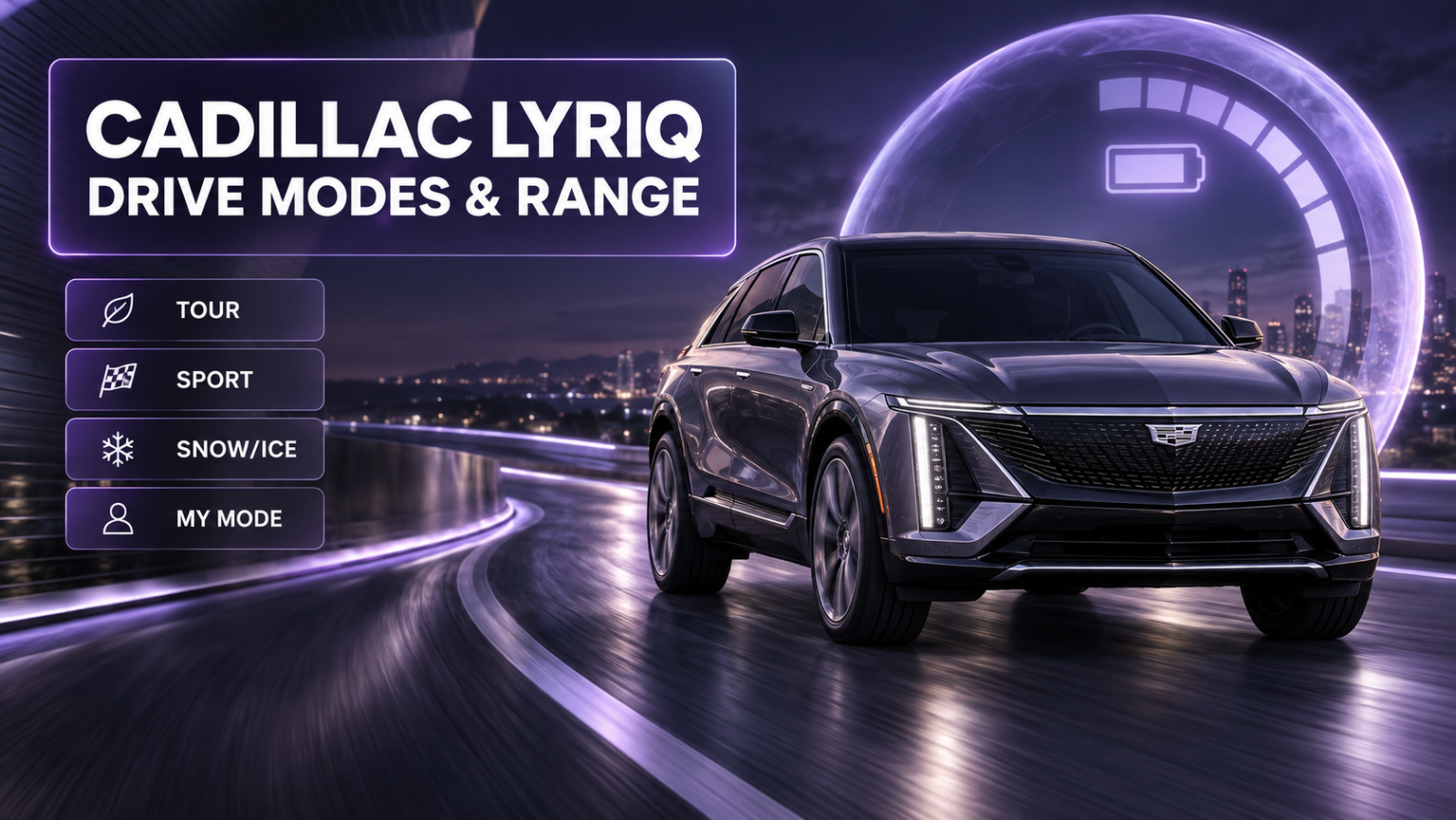
The Cadillac LYRIQ’s driving modes can affect real-world battery usage, but they do not unlock different battery capacities or provide separate fixed range limits.
Selecting Sport instead of Tour does not physically shrink the battery or reserve part of its charge. The difference comes from how each mode changes accelerator response, steering, traction management and other driving characteristics. Those changes can influence how aggressively the vehicle is driven—and therefore how much electricity it consumes.
For most drivers, Tour is the best everyday setting for consistent efficiency. Sport may consume more energy when its sharper responses encourage harder acceleration, while Snow/Ice is designed for traction rather than maximum range.
The Important Distinction: Available Energy vs. Energy Consumption
Two ideas are often confused when discussing EV drive modes:
- Available battery energy is the usable electricity stored in the battery.
- Energy consumption is how quickly the vehicle uses that electricity while driving.
Changing the drive mode normally affects the second item, not the first. The same usable battery remains available, but the rate at which the LYRIQ consumes energy can change because of the driver’s inputs and road conditions.
There is no separate “Sport range” or “Snow/Ice range” stored in the vehicle. Real-world range is the result of energy consumption over time.
How Each Cadillac LYRIQ Drive Mode Can Affect Efficiency
Available modes can vary by model year, equipment and whether the vehicle is a standard LYRIQ or LYRIQ-V.
| Driving mode | Primary purpose | Likely range effect |
|---|---|---|
| Tour | Comfortable everyday driving | Usually the most consistent choice for efficiency |
| Sport | Sharper, more responsive driving | May increase consumption if used aggressively |
| Snow/Ice | Better control on slippery surfaces | No guaranteed range benefit; winter conditions usually matter more |
| My Mode | Personalized vehicle responses | Depends on the selected settings and driving style |
| V-Mode or performance settings | Maximum customization and performance on LYRIQ-V | Greater energy use is possible when performance is frequently used |
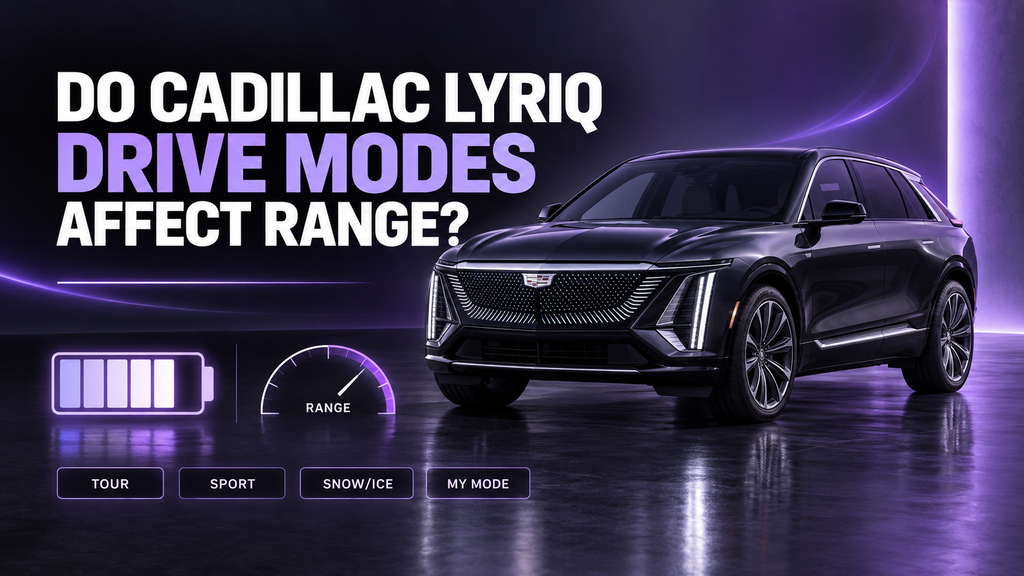
Tour: The Sensible Everyday Baseline
Tour is the default mode and the most appropriate starting point when range matters. It provides normal accelerator response and an everyday balance between comfort and performance.



Tour does not create extra battery energy. It simply makes smooth, moderate driving easier. Gentle acceleration, stable speeds and early deceleration generally help more than the name of the selected mode.
For commuting, highway travel and ordinary city driving, leaving the LYRIQ in Tour is usually the simplest approach.
Sport: Higher Usage Is Possible, but Not Automatic
Sport mode produces a more immediate and performance-oriented driving experience. A smaller accelerator movement may feel more responsive, and the steering can feel firmer.
The mode itself does not continuously drain a large amount of additional power. If the LYRIQ is driven at the same speed, on the same road and with equally gentle accelerator inputs, the difference may be modest.
In practice, however, Sport mode makes quick acceleration more accessible. Repeated acceleration, higher speeds and frequent changes in speed require more energy. Therefore, a driver using Sport enthusiastically will probably see higher battery consumption than a driver moving smoothly in Tour.
The correct conclusion is that Sport mode can reduce range indirectly through driving behavior—not that selecting it immediately removes a fixed number of miles.
Snow/Ice: A Traction Setting, Not an Economy Mode
Snow/Ice mode modifies accelerator or torque response to reduce wheelspin on slippery roads. Softer power delivery can feel more gradual, but this mode is intended to improve control rather than extend range.
Cold temperatures, cabin heating, snow-covered roads and increased rolling resistance can all raise energy consumption. These conditions usually have a much larger effect than the drive-mode selection itself.
Do not use Tour merely to chase better efficiency when Snow/Ice is more suitable for the road. Maintaining traction and control should remain the priority.
My Mode: Efficiency Depends on the Configuration
My Mode allows supported vehicle responses to be personalized. The available adjustments depend on the LYRIQ’s model year and equipment.
A comfortable configuration combined with smooth accelerator inputs may deliver consumption similar to Tour. A more responsive configuration may encourage the driver to accelerate harder and use more energy.
My Mode should therefore be viewed as a customization feature, not as a dedicated range-saving mode.
LYRIQ-V Performance Modes
The LYRIQ-V adds performance-focused capabilities that are not available on every standard LYRIQ. Depending on the model, these may include V-Mode, Velocity Max or other configurable performance settings.
Using maximum acceleration or repeatedly accessing the vehicle’s higher performance will consume more energy. However, owning a LYRIQ-V or selecting a configurable mode does not mean energy consumption will always be high. The actual result still depends heavily on speed, acceleration and driving conditions.
Regenerative Braking Matters More in City Driving
The LYRIQ’s regenerative-braking features are related to efficiency, but they are not the same as Tour, Sport or Snow/Ice modes.
Regen On Demand and One-Pedal Driving use the electric motor to slow the vehicle and return some of its kinetic energy to the battery. They can be particularly useful in urban traffic, where the vehicle repeatedly slows for intersections and congestion.
Regeneration cannot recover all the energy previously used to accelerate. Some energy is always lost through aerodynamic drag, rolling resistance and conversion losses. The most efficient approach is still to avoid unnecessary acceleration and braking.
On an open highway, regenerative braking offers fewer opportunities because the vehicle spends more time maintaining a steady speed. Aerodynamic drag and cruising speed become much more important.
Drivers should also remember that regenerative braking may be limited when the battery is very full or extremely hot or cold. Cadillac advises using the regular brake pedal whenever stronger or emergency braking is required. One-Pedal Driving and Regen On Demand may also be unsuitable on slippery roads, so drivers should follow the instructions for their specific model year.
What Usually Changes LYRIQ Range More Than Drive Mode?
The following factors can create a larger difference than switching between Tour and Sport:
- Highway speed: Air resistance rises rapidly as speed increases.
- Hard acceleration: Frequent use of strong motor output consumes more energy.
- Outside temperature: Very cold or hot conditions can affect the battery and climate-control demand.
- Cabin heating and cooling: Heating or cooling the interior draws energy from the high-voltage battery.
- Elevation and terrain: Long climbs require additional energy, although some may be recovered while descending.
- Tire pressure and wheel choice: Low pressure and larger performance-oriented wheels can increase resistance.
- Cargo and towing: Additional weight and aerodynamic drag raise consumption.
- Rain, snow and wind: Poor weather can increase road resistance or aerodynamic load.
A driver cruising quickly in Tour may use more energy than a driver moving smoothly in Sport. The mode matters, but the driver’s right foot and the operating conditions matter more.
How to Compare the Modes in Your Own LYRIQ
Owners can perform a simple comparison without relying only on the estimated range shown on the dashboard:
- Choose a repeatable route with a mixture of city and highway driving.
- Begin each test at a similar battery state of charge.
- Keep tire pressure, passenger load and climate settings consistent.
- Reset the relevant trip or energy-consumption display.
- Drive the first run in Tour and the next in Sport.
- Maintain similar speeds and acceleration whenever traffic allows.
- Compare the displayed efficiency, such as miles per kilowatt-hour.
For a more meaningful result, repeat each mode more than once. Temperature, wind and traffic can distort a single trip.
This is an owner comparison rather than a laboratory test, but it can show whether a particular mode changes how you personally drive.
The Practical Answer
Cadillac LYRIQ driving modes do not offer different fixed battery capacities or guaranteed ranges. They change how the vehicle responds, which can indirectly affect energy consumption.
Tour is generally the best choice for predictable everyday efficiency. Sport can use more battery when its responsive character leads to stronger acceleration. Snow/Ice prioritizes traction, while My Mode and LYRIQ-V settings produce results based on their configuration and how they are used.
For maximum practical range, concentrate on smooth acceleration, moderate highway speeds, sensible climate settings and proper tire pressure. Those habits will normally make a greater difference than repeatedly changing drive modes.
Read more :Tubehalote.com Explained: What the Site Really Is
